
CEO Executive Coaching - Transform Leadership 2026
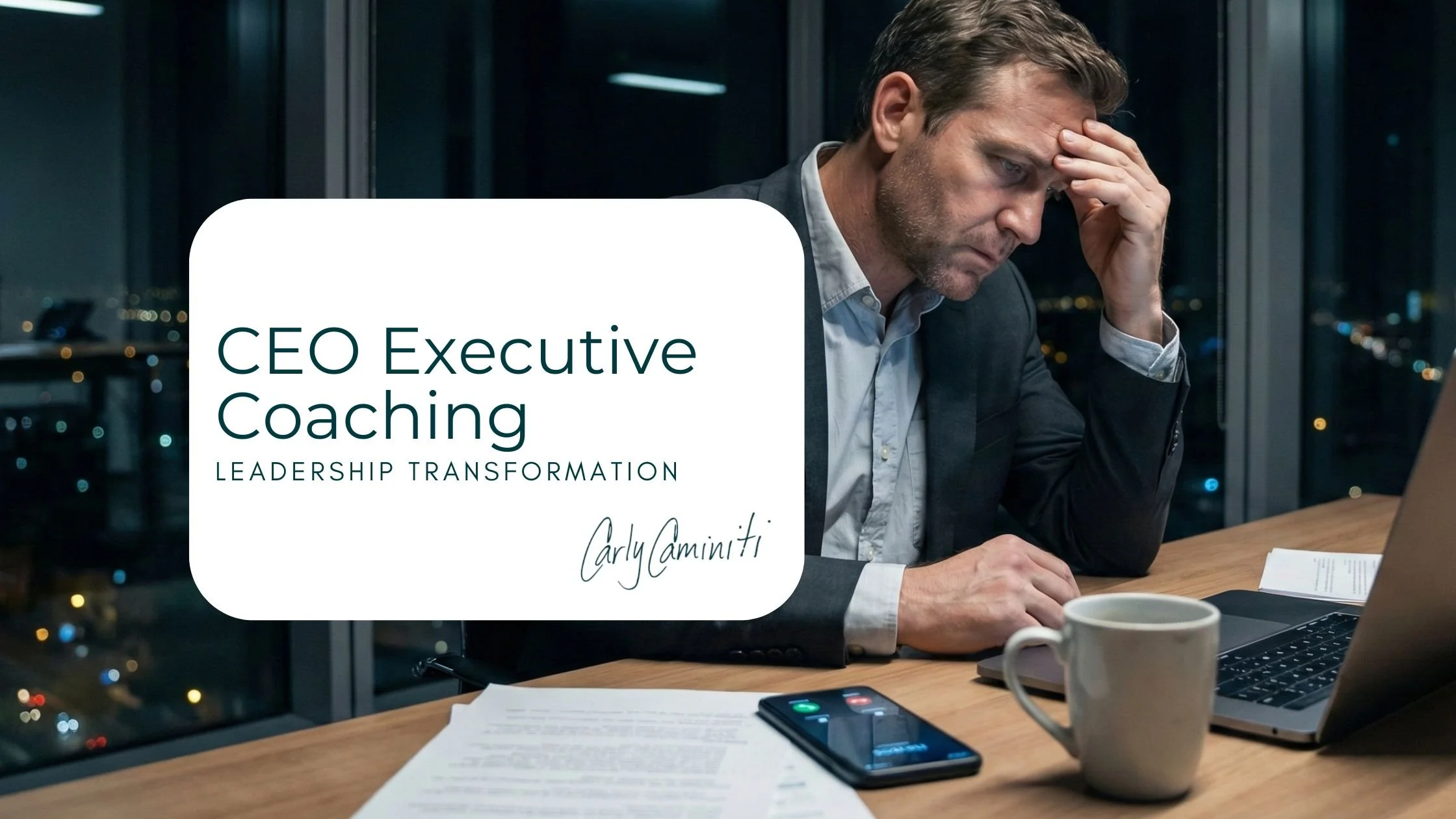
CEO executive coaching has become essential as leaders face unprecedented complexity in today's business landscape. The challenges go beyond strategy and operations, they include navigating AI transformation, managing distributed teams, and maintaining performance under intense scrutiny. If you're considering whether coaching is right for you, understanding what makes CEO coaching distinct from other development approaches is your first step.
The stakes have never been higher. Recent data shows CEO tenure has dropped to 4.5 years, while the CEO Confidence Index sits at just 49.6 out of 100. Yet companies that invest in executive coaching report remarkable returns, with some achieving 788% ROI when factoring in productivity and retention gains.
Also Read:
Table of Contents
TL;DR: CEO Executive Coaching
CEO executive coaching gives you a confidential, high-trust space to think clearly, lead decisively, and perform at a higher level when the role gets complex and lonely. Done right, it strengthens the outcomes that actually matter: faster and better decisions, sharper strategic focus, more effective delegation, a stronger executive team, healthier leadership presence under pressure, and fewer repeat mistakes driven by blind spots. If you feel stretched between growth demands, constant scrutiny, and personal sustainability, coaching helps you cut through noise, translate insight into consistent leadership behavior, and build momentum you can measure. You do not need to keep guessing; clarity and control are achievable with the right coaching partnership.
Key Points:
CEO coaching addresses unique challenges like isolation, strategic complexity, and high-stakes decision-making that other leadership development approaches don't target
Measurable benefits include 5-7x average ROI, improved strategic decisions, enhanced team performance, and better work-life integration
The coaching process involves deep assessment using 360-degree feedback, personalized goal-setting, bi-weekly sessions, and continuous progress tracking
Choose coaches with ICF PCC/MCC credentials, 500+ hours of executive-specific experience, and proven results with leaders in similar situations
Ideal timing includes growth transitions, when facing performance blind spots, or proactively before challenges emerge

What CEO Executive Coaching Is (And Why It's Different)
CEO executive coaching provides a confidential partnership focused on unlocking your highest potential as an organizational leader. Unlike generic leadership training or management workshops, this specialized approach targets the distinct pressures and opportunities that come with sitting in the top chair. You work one-on-one with a professional executive coach who brings both business acumen and behavioral expertise to help you navigate complexity, strengthen decision-making, and lead with greater impact.
The transformation happens through structured yet flexible engagements built on trust and candor. Your coach serves as an objective sounding board, challenging assumptions and illuminating blind spots that naturally emerge at the executive level. This isn't about fixing what's broken. It's about elevating what's already strong and developing new capabilities for the challenges ahead.
The Unique Challenges CEOs Face
You carry responsibilities that no one else in your organization fully understands. Strategic misalignment creates significant pressure. 98% of board members identify measuring AI ROI as a priority, compared to just 33% of CEOs, highlighting gaps that land squarely on your shoulders. The uncertainty has intensified dramatically, with 43% of US CEOs ranking it as their top economic threat for 2026, significantly exceeding the 29% global average.
You also navigate distinct risk exposure. Cyberattacks now rank as the #1 geopolitical threat, with 54% of US CEOs citing it as a top concern. Research shows 13.9% of CEOs view trust in media as a top challenge, nearly triple the 5.0% rate among other executives.
The isolation compounds these pressures. You can't always share strategic concerns with your team, and board dynamics require careful navigation. Beyond external pressures, you face internal struggles with delegation, succession planning, and maintaining authentic relationships when everyone wants something from you.
How CEO Coaching Differs from Other Leadership Development
CEO coaching diverges from VP or director-level executive coaching in scope, depth, and methodology. While mid-level coaching focuses on operational execution and team management, your coaching addresses enterprise-wide strategy, long-term vision, and whole-system impacts like mergers or organizational transformation. The stakeholder complexity you navigate extends far beyond functional teams, encompassing board dynamics, investor relations, and multi-level coalitions.
Assessment depth differs dramatically as well. CEO engagements employ ongoing 360-degree feedback and psychometric tools specifically designed to identify blind spots at the highest leadership levels. The methodology prioritizes adaptive mindsets and resilience under extreme stakes rather than tactical skill-building.
Traditional leadership development delivers standardized content to groups. Executive coaching for CEOs provides personalized guidance from coaches who often bring their own executive experience. This creates a partnership between equals rather than a teacher-student dynamic, allowing for the vulnerability and candor necessary for breakthrough growth.
Measurable Benefits of CEO Executive Coaching
The ROI of executive coaching extends well beyond soft skills into hard business metrics. Organizations tracking coaching impact report a median ROI of 7x their investment, with 86% of companies at least recouping their initial investment. The benefits manifest across three critical dimensions: strategic capability, leadership effectiveness, and personal sustainability.
Strategic Decision-Making and Business Growth
Executive coaching sharpens your ability to make high-quality decisions under pressure and uncertainty. One CEO struggled with whether to pursue an aggressive acquisition that could double revenue but required significant debt. Through coaching sessions using a structured decision-framework, they mapped out second and third-order consequences across stakeholder groups. The process revealed that their board's risk tolerance was misaligned with the strategy, prompting productive conversations that ultimately led to a modified approach. The acquisition proceeded at 60% of the original scale, achieved projected synergies within 18 months, and maintained board confidence throughout.
Companies with coached CEOs achieve 25.9% revenue compound annual growth rates, significantly outpacing industry benchmarks. The advantage comes from developing better strategic instincts, spotting opportunities earlier, and executing with greater confidence.
With 46% of US CEOs identifying measuring AI ROI as their top priority and only 30% confident about revenue growth in 2026, the ability to make sound decisions amid volatility becomes a competitive advantage. Executive coaching for leadership development builds this capability systematically.
Leadership Effectiveness and Team Performance
Your leadership style cascades throughout the organization, influencing culture, engagement, and performance at every level. Studies show 77% of executives report coaching impacted at least one major business metric, with improvements appearing in team productivity, innovation, and retention.
Consider a CEO whose 360-degree feedback revealed they were perceived as dismissive during strategy discussions, shutting down alternative viewpoints. Through coaching, they implemented a "listen-first" practice in meetings, asking three clarifying questions before offering their perspective. They also scheduled one-on-ones specifically to solicit dissenting opinions from key leaders. Within 90 days, their direct reports reported feeling more valued, and the executive team began surfacing strategic concerns earlier rather than after decisions were made. Six months later, repeat 360 feedback showed their "openness to input" scores improved from the 12th to 76th percentile.
These capabilities strengthen team cohesion and create environments where high performers thrive. Leadership effectiveness multiplies when executives learn to lead themselves before leading others.
Personal Development and Work-Life Integration
Sustainable high performance requires attending to your own wellbeing alongside business demands. Executive coaching addresses the personal toll of leadership, helping you manage stress, establish healthy boundaries, and maintain perspective.
Your coach helps you audit habits and identify where your energy goes. Many CEOs discover they're trapped in reactive patterns, constantly responding to urgencies rather than creating space for strategic thinking. Together, you design new routines that protect time for reflection, family, and renewal. You also develop practices for managing the emotional intensity of leadership, from handling criticism constructively to processing disappointment without losing momentum.
Work-life integration acknowledges that you can't compartmentalize completely. Your coach helps you make conscious choices about where you invest attention, ensuring alignment between your values and daily actions. This integration reduces internal conflict and increases satisfaction both at work and home.

How the CEO Coaching Process Works
The executive coaching process follows a structured yet flexible framework designed to create lasting transformation. Effective engagements share common elements that maximize impact and ensure accountability.
Initial Assessment and Goal Setting
Your coaching relationship begins with comprehensive assessment to establish baselines and identify focus areas. This phase employs 360-degree feedback from board members, direct reports, and peers; psychometric assessments measuring personality, emotional intelligence, and leadership style; and in-depth interviews exploring your background, strengths, and aspirations.
The multi-source feedback reveals how others experience your leadership, often surfacing blind spots you didn't recognize. Your coach synthesizes all this data, interpreting results through the lens of your specific organizational context. Together, you define 1-3 high-impact development goals tied to measurable business outcomes, improving decision speed, strengthening stakeholder relationships, or developing successors. Clear success metrics established upfront enable you to track progress and demonstrate ROI.
Ongoing Coaching Engagement Structure
Most CEO coaching programs follow a phased structure spanning 6-12 months with bi-weekly or monthly sessions. In one typical engagement, a CEO arrived at their third session frustrated about a product launch that had missed key milestones. Rather than problem-solving the immediate crisis, the coach asked them to map out their decision-making process from conception to execution. Using a structured framework, they identified three points where assumptions went untested. Customer willingness to switch platforms, internal team capacity during Q4, and supplier reliability under volume pressure.
The coach then role-played how to address these gaps with the executive team without assigning blame. They practiced framing it as a learning opportunity and establishing better validation checkpoints for future initiatives. Two weeks later, the CEO reported that the debrief session had been their most productive team meeting in months, generating enthusiasm for course corrections rather than defensiveness.
Sessions last 60-90 minutes and combine reflection on recent experiences with forward-looking strategy. Between sessions, you receive accountability touchpoints through progress reports or brief check-ins. The structure remains flexible to accommodate emerging priorities, ensuring the coaching stays relevant rather than rigidly following a predetermined agenda.
Measuring Progress and ROI
Effective coaching includes robust measurement systems tracking both behavioral changes and business impact. You revisit 360-degree feedback at the engagement midpoint and conclusion, comparing results to baseline scores. Key performance indicators might include decision quality, team engagement scores, strategic initiative success rates, or specific financial metrics tied to your goals.
Many coaches employ frameworks calculating ROI as net benefits divided by coaching costs, multiplied by 100. When tracked systematically, organizations typically see returns between 500-1400%, validating the investment. Regular progress reviews every 30-60 days ensure the coaching remains on track, preventing drift and maintaining accountability on both sides.
Types of CEO Coaching Approaches and Formats
CEO coaching programs come in various formats, each offering distinct advantages depending on your needs, learning style, and organizational context.
One-on-One Executive Coaching
One-on-one sessions provide the most personalized CEO coaching services available. You receive undivided attention from an experienced coach who tailors every conversation to your specific challenges and opportunities. The confidential nature of this format creates psychological safety for exploring sensitive topics like succession anxiety, board conflicts, or self-doubt.
Marshall Goldsmith's feedforward methodology exemplifies effective one-on-one approaches, focusing on future-oriented behavioral change rather than analyzing past mistakes. His structured feedback mechanisms target measurable leadership improvement, with engagements typically lasting 12-18 months for Fortune 500 CEOs. The intensity of one-on-one work accelerates development timelines, proving especially valuable during inflection points like mergers, leadership transitions, or crisis management.
Group CEO Coaching and Peer Advisory
Group executive coaching and peer advisory programs bring together CEOs from non-competing organizations to learn from shared experiences. Vistage's dual-structured model combines monthly peer group meetings with one-to-one coaching from accomplished Chairs who are former executives. This framework creates accountability and actionable insight for leaders navigating acquisitions, restructuring, succession planning, and market expansion.
The power of this format lies in collective wisdom. Members report significant business impact, including 2.2x faster growth and 4x greater business longevity than non-members. When you present a dilemma, you receive input from executives who've faced similar situations, often in different industries. This cross-pollination sparks creative solutions you might not discover alone.
Peer groups foster accountability through regular commitments and follow-up. The relationships often extend beyond formal sessions, becoming a trusted network for advice and support. However, this format requires high commitment, typically involving monthly full-day meetings, and may lack the personalized depth of one-on-one coaching.
Specialized Coaching Focus Areas
Some coaching engagements target specific competency areas rather than broad leadership development. Specialized programs might focus on crisis management, innovation leadership, succession planning, or executive presence. The Center for Creative Leadership's evidence-based approach uses 360-degree assessments, peer cohort discussions, and applied learning modules, with 12-month engagements aligned to corporate leadership pipelines.
Modern coaching increasingly employs AI-powered analytics combined with psychometric assessments and real-time performance dashboards. Personalized development plans use deep data insights from digital collaboration metrics and ongoing 360° feedback, ensuring each CEO's coaching journey aligns with their unique strengths and blind spots. McKinsey research indicates AI-driven coaching solutions can increase effectiveness by 40% through enhanced customization.
Emotional intelligence and stress resilience training has become another critical focus area, helping leaders navigate uncertainty, manage interpersonal relationships, and build team trust. Practical techniques include mindfulness training, scenario planning, and reflective questioning to develop mental endurance.
Choosing the Right CEO Executive Coach
Selecting your coach ranks among the most important decisions in your development journey. The right partnership accelerates growth and delivers exceptional returns. Approach the selection process with the same rigor you'd apply to hiring a key executive.
Essential Qualifications and Experience to Look For
Start by verifying professional credentials from recognized coaching organizations. Look for International Coaching Federation PCC or MCC certification, which requires 125+ hours of coach-specific education, 500+ hours of experience with at least 450 paid hours, 10 hours of mentor coaching, performance evaluation, and passing a credentialing exam.
Beyond baseline certification, seek coaches with substantial executive-focused experience. The threshold should be at least 500 hours specifically coaching executives on leadership development, strategic planning, conflict resolution, and organizational transformation. Ask for case examples demonstrating their work with leaders in situations comparable to yours.
Industry knowledge matters less than you might think, but organizational complexity expertise proves essential. Your coach should understand board dynamics, investor relations, and navigating matrixed stakeholder ecosystems. Former CEOs or senior executives often bring valuable perspective, though excellent coaches come from diverse backgrounds.
Questions to Ask Potential Coaches
When you hire a leadership coach, conduct thorough interviews. Start with "What certifications and professional credentials do you hold?" This establishes their professional foundation. Follow with "What is your track record of results with leaders in similar positions to mine, and can you provide specific examples?" Press for concrete outcomes, not just process descriptions.
Explore measurement by asking "How do you assess progress and measure success, and what metrics will we track throughout our engagement?" Strong coaches articulate clear frameworks for demonstrating value. Address confidentiality directly: "What is your approach to confidentiality, and how will you maintain objectivity?"
Inquire about methodology: "How do you adapt your coaching style to individual learning preferences?" Also ask "What is your understanding of our industry and organizational context?" to gauge preparation. Finally, discuss a real challenge you're facing and observe how they engage. Do they listen deeply? Ask insightful questions? The chemistry between you matters enormously.
Red Flags and What to Avoid
Certain warning signs should immediately disqualify a potential coach. Lack of formal certification or training from recognized programs indicates insufficient foundation. Being a successful leader doesn't automatically make someone an effective coach.
Avoid coaches who use high-pressure sales tactics or push you to commit during initial conversations. Inconsistent session quality or poor recall of previous discussions indicates the coach is overextended. Be wary of coaches lacking proven methodologies or frameworks, or those who promise unrealistic outcomes.
Watch for coaches who dominate conversations with their own stories rather than drawing out your thinking. While sharing relevant experience can be valuable, coaching primarily involves asking powerful questions. If you leave sessions feeling heard and challenged, that's good coaching. If you leave with lecture notes, that's consulting masquerading as coaching.
When CEOs Should Consider Executive Coaching
Timing significantly impacts coaching effectiveness. While executive coaching benefits leaders at any stage, certain situations create optimal conditions for transformation.
Growth Transitions and Inflection Points
Major organizational changes create both opportunity and risk, making them ideal coaching moments. Leadership transitions like stepping into your first CEO position, merging companies, entering new markets, or launching significant strategic pivots all benefit from coaching support.
One CEO engaged coaching six months before a planned acquisition of a competitor twice their size. Early sessions focused on identifying integration risks, clarifying their leadership approach for the combined entity, and preparing for board scrutiny. When the deal closed, they had already mapped out their first 100 days, identified key talent to retain, and developed communication strategies for each stakeholder group. The integration proceeded ahead of schedule, achieving 85% of projected synergies in year one compared to the industry average of 50%.
Shifts toward emerging leadership styles also warrant coaching investment. If you're evolving from directive to transformational or authentic leadership, you need support navigating the transition. High-stakes stress during critical moments amplifies the value of having a trusted thinking partner.
Performance Challenges and Blind Spots
High executive turnover and short tenures signal derailment risk factors that coaching often addresses. If you're experiencing difficulty retaining top talent, facing criticism from your board, or seeing strategic initiatives consistently underperform, coaching can help identify root causes.
Blind spots around resilience become apparent when external volatility erodes your confidence. Struggles measuring AI ROI represent a key performance gap for many leaders. Short-term focus limiting strategic thinking creates another blind spot worth addressing. If you're allocating most time to immediate firefighting with little space for long-term planning, your coach helps you redesign routines that protect strategic thinking time.
When receiving feedback suggesting you micromanage, avoid difficult conversations, or struggle with delegation, coaching provides safe space to explore these behaviors. Addressing imposter syndrome at work or learning to stop second-guessing yourself often underlies surface-level performance challenges.
Proactive Leadership Development
The most sophisticated leaders engage coaching proactively rather than waiting for crises. This anticipatory posture builds capabilities before you need them, creating competitive advantages and reducing derailment risk.
Proactive coaching helps you anticipate talent gaps and build leadership pipelines aligned with business strategy. Even when performing well, regular coaching resets habitual reactivity into deliberate leadership. Frameworks like "Stop-Start-Strengthen" help you audit behaviors, identifying what to eliminate, what to adopt, and what to amplify.
Engaging coaching as core infrastructure for high performance makes you better equipped to lead amid constant change. As 2026's accelerating priorities around AI, well-being accountability, and distributed work continue reshaping business, proactive development ensures you're shaping these forces rather than reacting to them.
Getting Started with CEO Coaching Programs
Once you've decided to engage coaching, thoughtful preparation maximizes your investment. The work you do before formal coaching begins significantly impacts outcomes and ROI.
Setting Clear Objectives and Success Metrics
Define what success looks like before selecting a coach or designing your program. Identify 1-3 high-leverage areas where development would create the most value. Connect your development goals to specific business outcomes, target measurable improvements like "reduce time to decision on strategic initiatives by 30%" rather than vague aspirations.
Gather baseline data before coaching starts. Conduct 360-degree feedback, review recent performance evaluations, analyze key business metrics you want to influence, and reflect on your own assessment. This baseline creates clear before-and-after comparisons proving coaching impact. Discuss metrics with key stakeholders including your board chair or trusted advisors. Gaining career clarity about where you're heading makes the entire process more focused.
Making the Business Case for Coaching Investment
While you might self-fund coaching, many CEOs secure organizational support requiring board approval. Tailor your presentation to directors' priorities, emphasizing financial returns like 39.2% EBITDA growth associated with coached CEOs alongside risk mitigation around leadership gaps.
Frame it as strategic investment in addressing growth barriers rather than remedial intervention. Use ROI frameworks showing expected returns, referencing research on typical coaching outcomes. Explain how coaching mitigates leadership derailment risk, supports successful transition management, and builds bench strength. Include testimonials or case studies from peer CEOs who've achieved measurable results.
What to Expect in Your First 90 Days
The initial phase establishes foundations for long-term success. Expect significant time in assessment during the first 2-4 weeks, completing feedback surveys, psychometric tools, and in-depth conversations. Your coach will synthesize assessment data and present findings, typically highlighting 2-3 key themes. Together, you'll draft an individual development plan outlining specific goals, success metrics, and milestones.
Early sessions focus on building the coaching relationship and establishing working rhythms. Expect quick wins in the first 30-60 days as you apply new frameworks to immediate challenges. Your coach might help you resolve a persistent team conflict, prepare for a critical board meeting, or make a difficult decision you've been avoiding.
As the 90-day mark approaches, you'll conduct your first formal progress review, assessing what's working and whether you're on track toward defined goals. This checkpoint ensures the coaching remains aligned with your evolving needs.
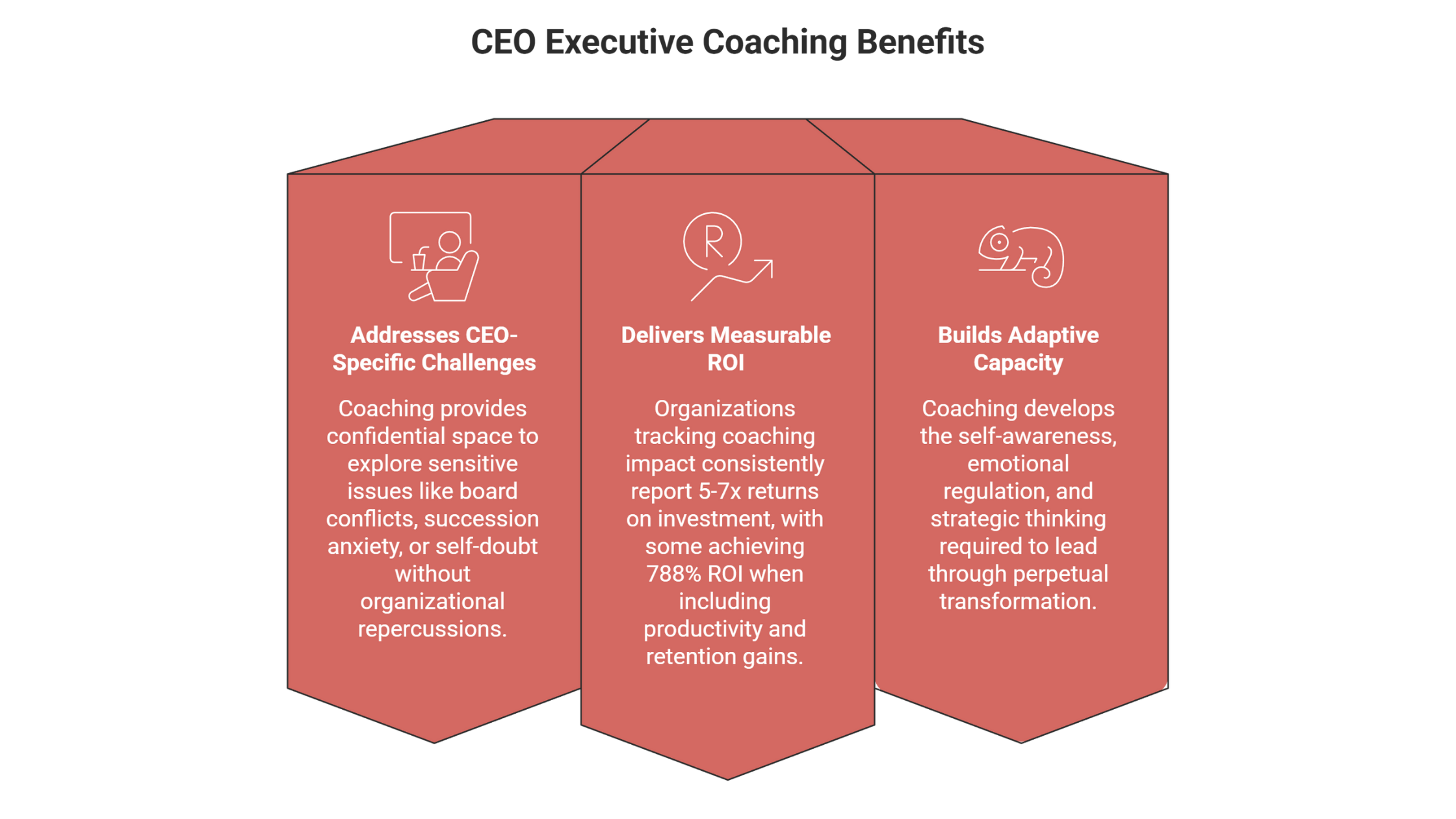
Top 3 Reasons CEO Executive Coaching Transforms Leadership in 2026
Based on current research and coaching outcomes, three factors make executive coaching particularly powerful for today's CEOs:
1. Addresses CEO-Specific Challenges That Other Development Can't Touch
The isolation, stakeholder complexity, and strategic scope of your role create unique pressures that VP-level training doesn't address. Coaching provides confidential space to explore sensitive issues like board conflicts, succession anxiety, or self-doubt without organizational repercussions.
2. Delivers Measurable ROI Through Behavioral Change
Organizations tracking coaching impact consistently report 5-7x returns on investment, with some achieving 788% ROI when including productivity and retention gains. You develop capabilities that directly impact decision quality, team performance, and financial results.
3. Builds Adaptive Capacity for Navigating Constant Change
With accelerating AI disruption, distributed workforces, and compressed business cycles, your ability to adapt quickly determines organizational survival. Coaching develops the self-awareness, emotional regulation, and strategic thinking required to lead through perpetual transformation.
Frequently Asked Questions About CEO Executive Coaching
What is executive coaching and how does it differ from consulting?
Executive coaching focuses on developing you as a leader through guided self-discovery, reflection, and behavioral practice. Your coach asks powerful questions and provides frameworks but doesn't tell you what to do. Consulting delivers expert advice and solutions for specific business problems. Coaching builds your capability to solve problems yourself.
Why is executive coaching important for CEOs specifically?
CEO roles create unique pressures including isolation, extreme stakeholder complexity, and enterprise-wide strategic responsibility that other positions don't face. Executive coaching benefits CEOs by providing confidential space to explore sensitive challenges, receive objective feedback, and develop capabilities specifically required at the top organizational level.
How much does CEO coaching typically cost?
CEO coaching services typically range from $15,000 to $50,000 for 6-12 month engagements, depending on coach experience, program structure, and included assessments. While this represents significant investment, the median 7x ROI and 86% success rate in recouping costs make it financially attractive.
What is the executive coaching process and how long does it take?
The executive coaching process typically spans 6-12 months with four phases: initial assessment and goal-setting, development planning, active coaching with bi-weekly sessions, and final evaluation. Some CEOs continue with quarterly maintenance coaching after completing intensive programs to sustain momentum.
How do I know if I need executive coaching versus other development options?
Consider executive coaching when facing CEO-specific challenges like board dynamics, succession planning, or enterprise strategy that team training doesn't address. It's ideal when you need confidential space for vulnerability, personalized development tied to specific goals, or support navigating major transitions. Group team coaching works better for developing your leadership team collectively.
What executive coaching methodologies are most effective?
Effective executive coaching methodologies combine 360-degree feedback, psychometric assessments, clear goal-setting, regular accountability sessions, and measurement of behavioral change and business outcomes. The specific approach matters less than the coach's ability to customize for your needs while following proven frameworks that produce results.
Conclusion
CEO executive coaching represents one of the highest-leverage investments you can make in your leadership and organizational performance. The combination of personalized attention, proven methodologies, and focus on measurable outcomes creates transformation that generic training cannot match. As business complexity continues increasing in 2026, having a trusted thinking partner becomes essential.
The most successful CEOs view coaching as ongoing infrastructure rather than one-time intervention. They recognize that continuous development keeps them sharp, adaptable, and ready for whatever challenges emerge next. Whether you're navigating a major transition, addressing performance blind spots, or proactively building capabilities, the right coaching partnership accelerates your growth and multiplies your impact.
Carly Caminiti has guided numerous executives through transformational coaching journeys, helping them lead with greater confidence, clarity, and effectiveness. Her approach combines deep expertise in leadership development with practical frameworks that produce measurable results. If you're ready to elevate your leadership and unlock your full potential, explore how 1:1 executive coaching can support your goals.
Don't wait for a crisis to engage coaching. The leaders who achieve the greatest results are those who commit to continuous growth before they absolutely need it. Your future self and your organization will thank you for making this investment today.
Ready to transform your leadership? Contact Carly Caminiti to discuss how executive coaching can help you achieve your most ambitious goals and navigate 2026's leadership challenges with confidence.